

Location: 8000 Van Nuys Boulevard, Panorama City, California 91402
Marty McFly here, dusting off the DeLorean for the first San Fernando Valley Blog Back to the Future trip in more than a decade.
For nearly 45 years, the General Motors Van Nuys Assembly Plant employed generations of Southern California residents and manufactured everything from Chevrolet pickup trucks and family sedans to Camaros and Pontiac Firebirds.
The DeLorean has the required plutonium, some random garbage has been stuffed into Mr. Fusion, and the time circuits are set for February 1948. The flux capacitor is fluxing, the engine is running and—after sitting around since our last BTTF trip in 2015—the old time machine appears ready for another journey into the San Fernando Valley's past.
Hang on, because we're heading back to a time when one of the Valley's largest industrial employers stood along Van Nuys Boulevard.
Today, much of the property is occupied by a sprawling retail and industrial development appropriately named The Plant. Thousands of people shop and eat there without realizing that millions of Chevrolet, Pontiac, Buick and Oldsmobile automobiles were once assembled on the same land.
The factory helped support the postwar growth of Panorama City, provided thousands of union manufacturing jobs and gave the San Fernando Valley a significant place in American automobile history.
Unfortunately, because this is a Back to the Future trip, we already know how the story ends. The assembly line eventually stopped, the enormous buildings disappeared and a very different kind of “Plant” rose in their place.
But before returning to 2026, let's go back to the beginning.
General Motors Comes to the San Fernando Valley
General Motors began production at Van Nuys in December 1947. Public grand-opening festivities followed on February 19–21, 1948, drawing extensive coverage from newspapers throughout Southern California.
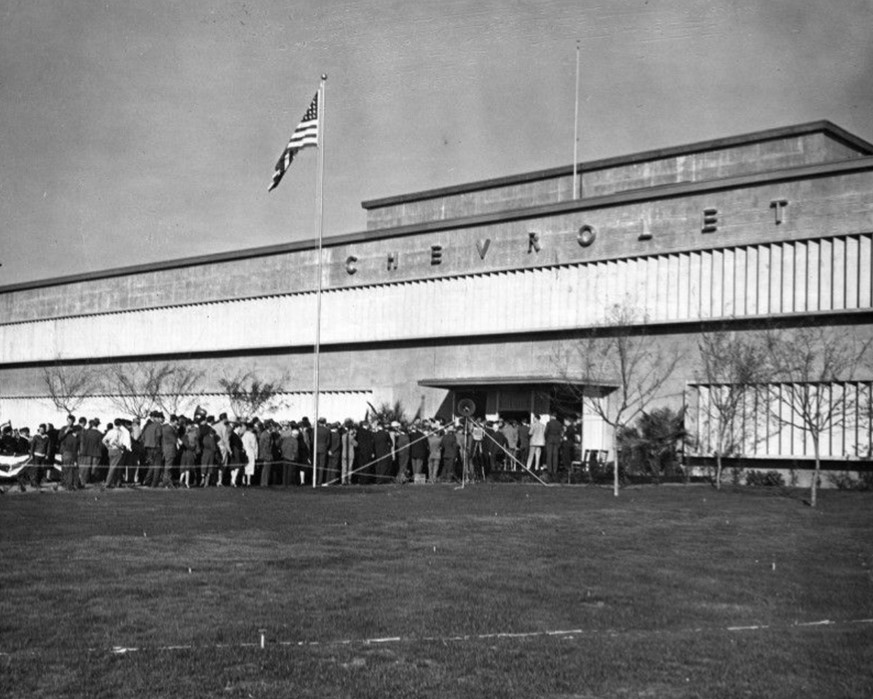
The factory initially assembled Chevrolet trucks and produced automobile bodies through GM's Fisher Body operation. More than 1,000 employees worked a single shift during its early years.

GM arrived at an extraordinary moment in Valley history. The agricultural landscape of the prewar era was rapidly giving way to subdivisions, shopping centers, industrial plants and new roads serving returning veterans and young families.
For many families, a GM job represented something increasingly associated with postwar America: enough income to purchase a modest house, raise children and enter the middle class without necessarily having a college degree.

Facebook commenter Rich Olmstead remembered a large field along the north side of GM where people grew onions and potatoes, possibly as a community garden. Source: Rich Olmstead, in David Cutter’s November 24, 2013 Facebook discussion.
Other memories place agriculture and industry side by side. Bob Beck recalled living across from the plant in 1961, in a house left from a chicken farm beside Carnation. Wayne Conant remembered an aunt’s berry farm near GM. These are personal recollections, not independently established parcel histories. Valley Relics reader recollections.
From the SFV Blog Archive
The GM plant has appeared on the San Fernando Valley Blog before. Two earlier posts provide additional visual context: a vintage Chevrolet assembly-plant postcard published in 2015 and the 2013 filming-location post documenting Best of the Best.


What Was Built in Van Nuys?
Van Nuys manufactured an unusually broad collection of General Motors vehicles during its lifetime. Early production included Chevrolet Advance Design trucks. As America's automobile market changed, GM repeatedly reconfigured the assembly lines.
Vehicles associated with Van Nuys production included Chevrolet full-size automobiles such as the Impala and Caprice, along with the Corvair, Greenbrier, Chevelle, Nova and Monte Carlo. The plant also produced related vehicles from other GM divisions, including the Buick Apollo and Skylark, Oldsmobile Omega and Pontiac Ventura.
But two cars became inseparable from the plant's later identity: the Chevrolet Camaro and Pontiac Firebird.

Second- and third-generation Camaros and Firebirds built in the Valley were shipped to dealerships and customers throughout the western United States.


By the time the factory closed, approximately 6.3 million automobiles had been produced at Van Nuys.
More Than an Automobile Factory
The plant's importance cannot be measured only by the number of cars it produced. Its payroll supported restaurants, markets, bars, repair businesses and other establishments throughout the surrounding community.
Historian Julia Brown-Bernstein's history of GM Van Nuys and its workforce describes a plant that drew workers not only from the Valley but from across Los Angeles County. Around the plant's late-1970s production peak, the union workforce numbered roughly 5,000 employees.
The workforce was far more diverse than the stereotypical image of the postwar San Fernando Valley. Latino, Black, white and Asian employees worked beside one another throughout the factory.

Former employees remembered Mike's Pizza and Carl's Jr., but three nearby bars became particularly associated with GM workers: Chevy Ho, The Trophy Room and Opie's. After spending eight, nine or sometimes even longer hours standing on concrete, a bar stool and cold beer offered a welcome change of scenery. Facebook recollections add another neighborhood perspective: Patrick Gagnon joked that he wished he had owned the bar across the street from GM, while Carl Whitman remembered that a window seat at Gina’s Little Italy offered a view of the new automobile displayed outside the plant.
David B. Goldenberg, who said he worked at Mike’s Pizza at Van Nuys Boulevard and Titus Street, remembered steak-sandwich orders leaving for the plant at lunchtime. Cliff Bernay recalled that his grandfather’s hardware store sold tools and precision instruments to GM workers. Vint Hunnicutt remembered selling newspapers at the exit, where an uncle would buy a copy and leave a small tip. Together, their accounts add a street-level view of the businesses supported by the factory’s daily routine. Valley Relics reader recollections.
Life on the Assembly Line
The nostalgia surrounding GM should not obscure what automobile manufacturing was actually like. The plant could be loud, dirty, repetitive and physically exhausting. Workers described bells, buzzers, machinery, moving chains and hundreds of voices creating a constant wall of sound.

One former Van Nuys employee who built Camaros and Firebirds between 1978 and 1981 remembered it as a pretty cool job—if you enjoyed monotony. Another man who briefly worked there in 1958 later joked that GM stood for “Grinding Madness.”
But the work came with an important tradeoff: comparatively strong union wages, health benefits and pensions. Brown-Bernstein's research places hourly pay at roughly $6 to $7 during the mid-1970s. Experienced workers also helped newcomers master difficult assembly jobs before mistakes could stop the line or cost them their jobs.
One small detail in the 2022 ICW account brings everyday factory life into focus: in December 1970, union representatives complained about meager vending-machine sandwiches and old food. The article also notes management's refusal to install cafeteria televisions. Break rooms were places where workers raised practical grievances and built relationships beyond their assembly stations.
The newer comments also describe particular jobs. Douglas Call recalled a brief 1957 stint moving front fenders between lines and fitting Bel Air trim; he found the repetition difficult. BunnyJohn Harrold remembered using an air hose to remove water before primer application on a paint-preparation line in the summer of 1959. David Komsak said he washed dishes and served food in the plant cafeteria while attending Van Nuys High School in 1972–1973. Valley Relics reader recollections.
Delivery work offered a different perspective. Kirk Herzog recalled bringing a rental forklift from Sam’s U Drive in the 1980s and driving through the plant after being directed to another side of the property. Security objected, he said, but the visit left him especially impressed by the coordination of four forklift operators unloading a truckload of tires. Valley Relics reader recollections.
South Gate Workers Come to Van Nuys
When GM's South Gate plant closed in 1983, hundreds of employees transferred to Van Nuys. Many were Black workers who continued living in South Los Angeles-area communities including Lynwood, Maywood, Inglewood and Compton. Some reportedly commuted more than 40 miles each way. Source: ICW, 2022.
The transfers initially created tension because company seniority rules meant longtime South Gate employees could compete for jobs and shifts held by employees with fewer years at Van Nuys. The possibility that GM might close Van Nuys too eventually gave both groups a common cause.
Solidarity Had to Be Built
Brown-Bernstein's interviews and archival research show that unity required deliberate work. Some Mexican immigrant workers sought Spanish-language materials and better meeting interpretation; participants proposed professional interpreters and headsets. Organizers also had to gain the trust of Black community leaders wary of the Valley's resistance to school integration. Saving the factory meant addressing these differences, not pretending they did not exist.
The Factory Was Part of Everyday Valley Life
Former residents repeatedly remember GM not as an isolated industrial site but as part of the everyday landscape. One commenter remembered living about a mile away and driving past it for years. Bob Petersen recalled hearing the plant’s noon whistle in a Facebook comment; that particular recollection remains unverified. Source: Bob Petersen, in David Cutter’s November 24, 2013 Facebook discussion.
Families frequently had multiple generations connected with the factory. One commenter could count six relatives who had worked there. Others remembered fathers, grandfathers, brothers, husbands and in-laws spending decades at GM.
For children, a parent’s GM job could mean more than a factory tour. Suzy Sincock recalled a large Christmas party for employees and their families, remembering it as the biggest party she had attended as a child. Valley Relics reader recollections.
The Factory Tour
GM Van Nuys also became a local attraction. Numerous Valley residents remember touring the factory as children with schools, Scout troops or their families. Visitors could watch automobile production from elevated walkways as bodies and completed vehicles moved through different stages of assembly.
One former Cub Scout remembered a mid-1960s visit where workers used specialized fixtures to accurately position exterior trim. Another person who toured the factory in 1967 remembered Camaros and Firebirds being manufactured in an environment that was dark, dirty and extremely noisy.
Some school visitors took home unusually memorable souvenirs. Chad Hendrix said he received a 396-engine sticker during a junior-high field trip and later put it on his own used SS396 Chevelle. David Fluke recalled a visit from Brookside in Oak Park in the early 1970s, when each child received a Camaro lug nut. His joking plan to assemble an entire car a piece at a time began—and ended—with that single part. Valley Relics reader recollections.
The New-Car Display on Van Nuys Boulevard
Several former residents independently remember a circular automobile display near the front of the factory where GM showcased a new vehicle to passing motorists.

Watching New Cars Leave the Valley
One former resident remembered an access road extending from Hazeltine Avenue toward Van Nuys Boulevard, passing the Schlitz brewery and the rear of the GM property. From there, he recalled seeing newly completed cars being loaded onto railroad cars for shipment.
Car haulers remember the plant from the other end of the journey. Michael Simon said he transported vehicles from Van Nuys for years and recalled taking its final outgoing load. That last-load claim remains to be verified; it should not be confused with the separately documented story of the final Camaro. Valley Relics reader recollections.

Fighting to Keep GM in the Valley
By the early 1980s, Van Nuys employees increasingly understood that California automobile manufacturing was in trouble. UAW Local 645 President Pete Beltran and labor organizer Eric Mann assembled a campaign that extended far beyond a conventional labor-management dispute.
They built a coalition connecting factory employees with Latino and Black civil-rights organizations, clergy members, elected officials and community groups throughout Los Angeles. The effort emerged publicly with a major rally outside the plant on May 15, 1983. Participants and speakers included César Chávez, Maxine Waters, Ed Asner, Congressman Howard Berman and Bishop Juan Arzube.
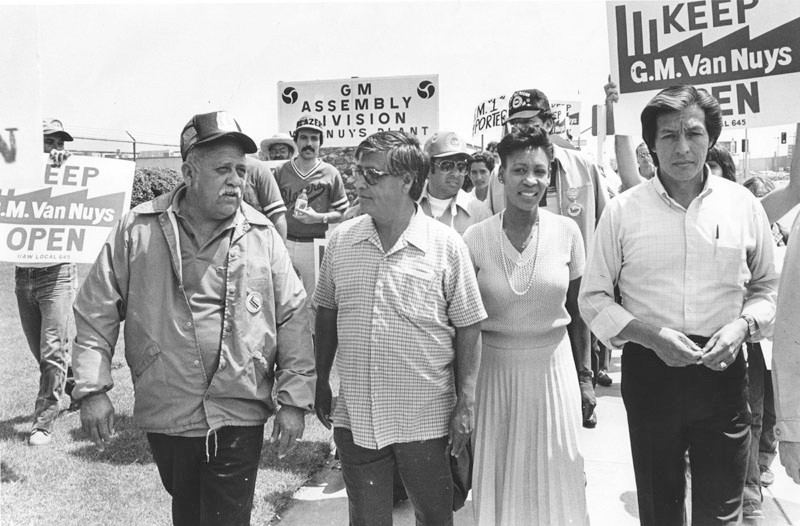
Writing in Pacific Standard in 2015, Laura Barraclough emphasized the campaign's wider argument: GM had obligations to the surrounding community, not just its shareholders and workers. In her account, resisting closure also meant challenging who should bear the costs of relocating production.
Ed Asner: More Than a Celebrity Supporter
In Eric Mann's 2021 recollection, Asner was an organizer, not simply a celebrity at the microphone. Asner had previously worked in auto plants in Kansas City and Chicago and belonged to the UAW.
Mann describes a 1984 Beverly Hilton meeting with GM President F. James McDonald. The coalition threatened a Southern California consumer boycott; Mann credits Maxine Waters with securing a three-year operating commitment. That was a reprieve, not a permanent guarantee. This is the campaign organizer's account of the negotiations.
The plant ultimately remained open until 1992—about nine years after the 1983 public rally.
Beltran's role is also examined in the Voices From the Frontlines tribute to Pete Beltran.

The Beginning of the End
By the end of the decade, GM had decided Camaro and Firebird production would move to Sainte-Thérèse, Quebec. A 2022 Los Angeles Times retrospective reported that Van Nuys was still producing approximately 406 automobiles per day as employees hoped GM might assign it another product.
But by 1992, GM was no longer willing to continue automobile assembly in Southern California.
1991 Firebird Quality: The Push for Improvement
The video below, supplied for this post under the title 1991 Firebird Quality, discusses improvements to the Firebird. It adds a different perspective to the plant’s final-era story: how vehicle quality was being presented. The video’s account should not be treated as an independent audit of the factory’s performance.
The Last Camaro
The final chapter has one remarkable surviving artifact: a red 1992 Chevrolet Camaro Z28 with Heritage black racing stripes—the last automobile produced by the plant.
Camaro enthusiast Leonard Stevenson learned about the impending shutdown while living in Iowa and began writing GM executives asking to purchase the final car. GM eventually agreed.
At approximately 5:30 a.m. on August 26, 1992, Stevenson was escorted through the huge factory until he reached the final Z28 moving down the production line. The Times reported that Van Nuys workers then had an average of approximately 20 years of service. Average pay was about $17 an hour, equivalent to roughly $35 per hour in 2022 dollars.

More Than 2,000 Signatures
As the final Camaro moved through production, employees began signing the components they installed. Names appeared on the driveshaft, door panels, transmission, rear axle and other parts hidden throughout the car. Painters reportedly signed beneath the seat in silver paint and sealed their names beneath clear coat.
When Stevenson returned the following morning, additional employees had come back specifically to add their names. Stevenson estimates that more than 2,000 people eventually signed the Camaro.
The car became a memorial to the plant. Its present-day license plate makes that connection explicit:
4UAW645

Contemporary coverage: Patrice Apodaca’s August 28, 1992 Los Angeles Times report. The newspaper scan remains in the chronological archive below.
The Human Cost of Closure
Brown-Bernstein's 2024 study adds personal details to the farewell: retiree Jose Casas returned with his mariachi band, while Virginia Miramontes picked a rose outside the factory. Juanita Washington mourned the loss of coworkers she regarded as family. The historian draws these accounts from contemporary reporting.
Approximately 2,600 workers remained when Van Nuys shut down. Some transferred to GM facilities elsewhere in the United States. Some accepted buyouts or retired earlier than anticipated. Others collected unemployment or returned to school to prepare for jobs in the growing service economy.
The shutdown also signaled something larger. Automobile factories in Pico Rivera, South Gate and Commerce had already disappeared. Van Nuys was the final major automobile assembly plant remaining in Los Angeles. The industrial decline more commonly associated with America's Rust Belt had reached the Sunbelt too.
Not every transfer took an employee out of California. Daryl Davis said he worked at Van Nuys from 1977 until closure and then transferred to a GM parts-distribution operation in Rancho Cucamonga. His recollection adds another individual outcome to the mix of relocation, retirement and retraining. Valley Relics reader recollections.
GM Van Nuys on Film: Hollywood and the Labor Campaign
The opening credits of the 1989 martial-arts film Best of the Best, starring Eric Roberts, James Earl Jones, Phillip Rhee and Chris Penn, include footage filmed inside the active Van Nuys plant. Former employees have said they recognize friends and coworkers in the footage.
The San Fernando Valley Blog previously examined the connection in Filming Locations: Best of the Best (1989).
Alabama: Forty Hour Week (For a Livin’)
Van Nuys filming location — to be verified: A Facebook commenter who said he worked on Alabama’s Forty Hour Week (For a Livin’) video recalled that its automobile-assembly sequences were filmed at GM Van Nuys. The video is included below for comparison, but this location claim has not been independently confirmed. The embed does not establish where the factory scenes were shot.
Tiger by the Tail: The Workers' Campaign on Film
The campaign has its own documentary: Tiger by the Tail, directed and edited by Michal Goldman, narrated by Ed Asner, with narration written by Eric Mann. Mann's account explains that it was made to support the organizing effort, preserving the campaign from its participants' perspective.
Mann also recalls a mishap during the documentary's narration shoot at Asner's Studio City office. The crew's lighting overloaded the electrical system, and the disrupted session produced a reading the filmmakers felt they could not use. When Mann raised the problem, Asner volunteered to try again and delivered a much stronger performance. This behind-the-scenes story is Mann's recollection, not an independently corroborated production record.
From General Motors to The Plant
After production ended, the huge assembly property entered a prolonged redevelopment process. The factory buildings were eventually demolished and much of the land was transformed into retail, restaurant, entertainment and industrial space.
The Los Angeles Times Valley Business cover of April 27, 1993, captured that uncertain interval with the headline “White Elephant.” The clipping below belongs to the period between the factory’s closure and its later redevelopment.

How the Replacement Took Shape
Julia Brown-Bernstein's 2024 study traces the February 1996 redevelopment agreement: Selleck Properties handled retail and the theater, while Voit took the industrial component. Public funding and earthquake-recovery incentives supported redevelopment. The first store, Party City, opened September 28, 1998.
Her analysis asks whether reopening the property restored livelihoods: new commercial activity did not necessarily replace union wages, benefits or workplace community.

The redevelopment returned economic activity to the property, but retail and service employment represented a very different economy from the highly concentrated union manufacturing jobs that GM had provided. Los Angeles Fire Department Station 81 was also constructed on part of the former GM property.
What Replaced the Factory Jobs?
Barraclough's “The Rise of Homelessness in the Valley” (October 8, 2015) begins with a newspaper photograph of a makeshift encampment near The Plant. She reads that juxtaposition as a picture of economic change: union manufacturing had given way to retail and service jobs she described as generally lower-paid and less secure.
Her argument connects that employment shift with declining unionization, stagnant wages and rising rents. Importantly, she does not claim the shopping center alone caused homelessness. Instead, she treats the site as a local example of those wider pressures on the ability to afford housing.

Did GM Keep a Test Facility Beside The Plant?
A 2013 Facebook history post stated that General Motors retained approximately 27 acres adjacent to the redeveloped property for automobile testing. The 2024 study records a 1996 plan for GM to retain approximately 27 acres for vehicle-emissions testing. This supports the older recollection’s historical basis, but does not establish operation in 2013 or continued use in 2026. Present-day use remains to be verified.
Remembering the Factory Today
The same study describes Raymond Álvarez and his father Ramón looking at The Plant and wondering whether In-N-Out or T-Mobile occupied the places where they had worked. For former employees, the shopping center could overlay a remembered factory floor. The businesses are those described in the 2024 article, not a new tenant survey.
Most shoppers entering The Plant today probably have little idea what once occupied the property. Yet pieces of the history survive. Automobile and labor murals around Van Nuys Boulevard preserve memories of the plant and UAW Local 645.

By 2022, former workers maintained a Facebook group with more than 500 members. Former employees scattered around the country still shared photographs, memories and stories about coworkers and occasionally attended reunions. A former-worker archive cited in Brown-Bernstein’s 2024 study is Van Nuys Plant 8000 Van Nuys Blvd 91409; access may require a Facebook sign-in or group membership.
People remember the factory tours. They remember the noon whistle. They remember the bars across the street. They remember relatives who spent 20 or 30 years there. And former employees remember one another.
Employee Memorabilia: Pins, Jackets and Books
The factory's legacy also survives in small objects carried home by employees. Commemorative pins, medallions and quality-program buttons are tangible reminders of the identity that developed around the Van Nuys plant and its workforce.


These pieces are small compared with the factory itself, but they provide a personal connection to the people who worked there—objects that could be worn, saved in a toolbox or drawer, and passed down long after the assembly line disappeared.
The study also describes department-photo memory books distributed on closing day. That documents employee keepsakes, not the provenance of the individual pins pictured here.
Joe Renteria recalled that his father received a medallion when he retired and had also kept a padlock associated with Fisher Body. His comment helps explain why such small objects matter to families, but it does not establish the ownership or distribution history of the particular pieces pictured here. Valley Relics reader recollections.
A Jacket from My Personal Collection
The GM Van Nuys jacket shown below is from my personal collection. These two photographs document a wearable keepsake alongside the plant's pins, medallions and printed memorabilia.


Books and Keepsakes Preserved by the Museum
The preservation effort also extends beyond family collections. In a January 14, 2015 donation announcement, The Museum of the San Fernando Valley thanked former employee and local artist Guy Newell for contributing GM artifacts. The museum described his employment as spanning 1959 to the 1992 closure and illustrated books, a medallion, and aerial views labeled 1947 and 1990.


The Other GM Landmark: Burbank's Training Center
General Motors also maintained another important Southern California operation at 1105 Riverside Drive in Burbank. The General Motors Training Center was part of a nationwide network used to train mechanics, sales personnel and other employees. The Mid-Century Modern facility was designed by architect William Pereira.
More information about its architectural history is available through the Los Angeles Conservancy.
The EV1 and Who Killed the Electric Car?
The Burbank property later became associated with one of the most controversial chapters in GM history. General Motors introduced the battery-powered EV1 during the 1990s but made the cars available through leases rather than traditional sales.
When GM terminated the program, lessees were required to return their cars despite efforts by some drivers to purchase them or extend the leases.
Returned EV1s in Van Nuys: A 2003 Report
An October 22, 2003 New York Times article, “Leased and Abandoned, Revolt of the EV-1 Lovers,” places part of this story in Van Nuys. The passage supplied from the article describes most EV1s as sitting on a large Van Nuys lot and reports GM's plan to dismantle them and recycle their parts.
Possible location near the former GM plant — to be verified: The storage lot may have been at or near the old assembly-plant property, but the quoted passage gives no street address. The separately documented 1996 plan for an emissions-testing site does not establish where these EV1s were stored.
The Burbank Storage and Protest
Dozens of returned EV1s were also stored at the former Riverside Drive facility in Burbank. That location should not be conflated with the Van Nuys lot described in the 2003 report.
Electric-car supporters established a vigil outside the property and attempted to prevent remaining vehicles from being transported away. The confrontation became one of the best-known sequences in the 2006 documentary Who Killed the Electric Car?.
The documentary portrayed the recall and destruction of most of the EV1 fleet as evidence that GM abandoned electric-car technology prematurely. GM disputed that interpretation, arguing that the program was not commercially sustainable and that servicing, parts availability and related obligations made selling the leased vehicles impractical.
Where Is General Motors in the Area Today?
After automobile production disappeared from Van Nuys, GM continued to maintain a corporate presence in Southern California. For many years, the company operated an advanced automotive-design studio in North Hollywood. The former studio was at 5350 Biloxi Avenue, North Hollywood, California 91601. GM’s January 2001 press announcement identifies the address and describes its entrance as being on Chandler Boulevard near Cahuenga Boulevard. This is the historical North Hollywood location, not a claim that GM still operates there.
GM ultimately relocated that operation to a larger Advanced Design and Innovation campus in Pasadena, where it announced an investment of approximately $71 million.
General Motors also maintains a Western Regional Office at 30930 Russell Ranch Road in Westlake Village, supporting corporate sales, service and marketing functions rather than automobile manufacturing. Westlake Village sits outside the traditional geographical boundary of the San Fernando Valley.
A Valley Legacy Built in Steel
The story of the Van Nuys GM plant follows a pattern repeated throughout Southern California. Agricultural land became a postwar factory. The factory helped support a rapidly growing suburban community. The community grew around stable industrial employment. The industrial economy eventually declined. And the enormous factory became retail, restaurants and warehouses.
But describing the story only in terms of land use misses what was really lost. General Motors gave thousands of workers enough earning power to purchase homes and raise families. The factory brought together people from communities throughout Los Angeles who might otherwise never have met. It created friendships, marriages, fishing buddies, union campaigns and generations of family stories.
Every surviving Van Nuys-built Camaro, Firebird, Impala, Nova or Chevrolet truck is therefore more than an old automobile. It is a surviving artifact from a time when cars weren't just driven through the San Fernando Valley.
They were built here.
And with that, it's time to climb back into the DeLorean, fire up Mr. Fusion and return to 2026.
Just be careful trying to reach 88 miles per hour on Van Nuys Boulevard.
Photo Archive: GM Van Nuys and Its Surroundings
Photographs are grouped by subject. Click any photograph for the shared lightbox; use the arrows to browse or open the original at full size. The newspaper archive follows separately in chronological order.
Factory Entrances, Signs and Grounds


Camaros, Firebirds and the Vehicle Lots


Assembly-Line Details and Final Production


Rail Lines, Service Yards and Van Nuys Boulevard


Site Views and Redevelopment


Murals and Neighborhood Reminders


Additional Archival Photographs
The newly supplied catalog images are retained together here because their exact image-to-record matches could not be verified. Dates, photographer names and more specific captions have not been inferred from download order. See the supplied UCLA, USC, CSUN and museum references.


GM Van Nuys in the Newspapers
Contemporary newspaper clippings arranged chronologically. Click any clipping to enlarge.
1947–1949: Construction, Opening and the Postwar Boom


1969–1970: High-Production Era


1985–1988: Layoffs, Labor Pressure and an Uncertain Future


1991–1992: Final Months and Closure


1993: After the Closure

Publication and date from the supplied filename.
Sources & Further Reading
The New York Times — California Motor City; Leased and Abandoned, Revolt of the EV-1 Lovers (October 22, 2003). The Van Nuys storage detail is drawn from the excerpt supplied for this post; the full article was not independently reviewed for this update.
General Motors — Los Angeles Design Studio press announcement, January 2, 2001 (5350 Biloxi Avenue)
Los Angeles Public Library — TESSA catalog record for the Trans Am assembly-line photograph
Eric Mann — Ed Asner and the GM Van Nuys campaign (2021)
Laura Barraclough — “The Rise of Homelessness in the Valley,” Pacific Standard, October 8, 2015
San Fernando Valley Blog — Van Nuys Chevrolet Assembly Plant Postcard
San Fernando Valley Blog — Filming Locations: Best of the Best (1989)
Water and Power Associates — Historic General Motors Van Nuys photographs
Clio — UAW Local 645 and the campaign to keep GM Van Nuys open
San Fernando Valley Blog — San Fernando Valley History & Back to the Future Series
Los Angeles Times — When Camaros and Firebirds Roamed the San Fernando Valley
Los Angeles Times — coverage of the final day at GM Van Nuys
Voices From the Frontlines — Pete Beltran and the campaign to keep GM Van Nuys open
Los Angeles Conservancy — General Motors Training Center, Burbank
San Fernando Valley Blog — Filming Locations: Best of the Best (1989)
ThirdGen.org — GM Van Nuys Assembly Plant discussion and photographs
ChevyInfo.net — Van Nuys plant photograph archive
Los Angeles Almanac — Southern California automobile manufacturing history
Archival photograph references: the UCLA, USC, CSUN and museum links below accompanied the additional photographs. Exact image-to-record matching, dates and individual photographer credits remain to be verified for the additional archival group.
UCLA Library — catalog record zz0002sqnf
USC Digital Library — record 2A3BF1PFYO1E
USC Digital Library — record 2A3BF1PFYRWT
USC Digital Library — record 2A3BF11YZ98S
USC Digital Library — record 2A3BF1PX4E3P
The Museum of the San Fernando Valley — GM artifacts donated by Guy Newell (2015)
CSUN Digital Collections / San Fernando Valley History — record 1558
CSUN Digital Collections / San Fernando Valley History — record 540
CSUN Digital Collections / San Fernando Valley History — record 567
CSUN Digital Collections / San Fernando Valley History — record 539
Community recollections in this article were drawn from comments shared by former GM employees, relatives and San Fernando Valley residents. Items explicitly marked “To be verified” are preserved as anecdotal memories and are not presented as independently established historical facts.
Facebook recollections cited in this article
House, vehicle-owner and neighborhood recollections. These passages paraphrase Facebook comments supplied to the SFV Blog, including Mary Ellen Bruen’s account of the family home; James Abadi’s IROC-Z recollection; Jon Patrick Park’s GTA story; and the bar and restaurant memories of Patrick Gagnon and Carl Whitman. The supplied discussion was associated with Valley Relics Museum. Valley Relics Museum on Facebook is a page link, not a direct link to those comments.
North-side garden and noon whistle. Rich Olmstead’s garden recollection and Bob Petersen’s noon-whistle comment were supplied from David Cutter’s November 24, 2013 post in Kids of the San Fernando Valley — Things we loved in the 50’s and 60’s. Find the group on Facebook (search link).
Additional Valley Relics discussion. GM Plant in Van Nuys, CA, 1950 — Valley Relics Museum. New passages draw on the accompanying comment transcript supplied for this revision, including David B. Goldenberg, Cliff Bernay, Vint Hunnicutt, Suzy Sincock, Chad Hendrix, David Fluke, Daryl Davis, Joe Renteria and other named readers. These personal memories have not been independently verified; the post link is not an individual-comment permalink.
Post a Comment